In short
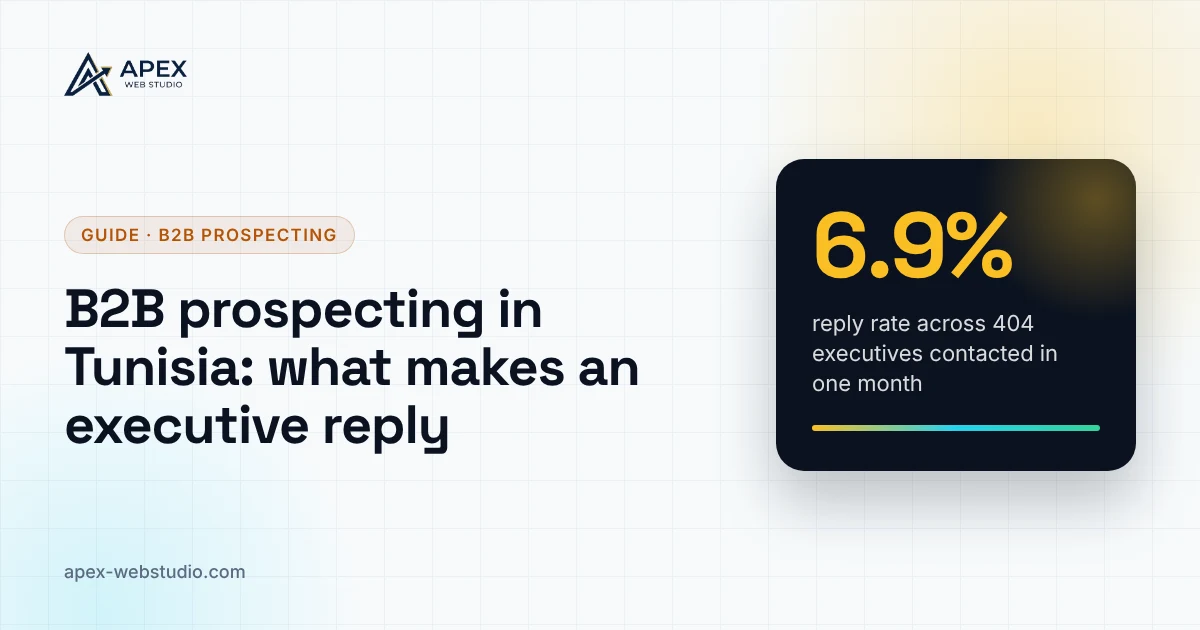
In Tunisia, B2B prospecting that gets replies rests on three things: a list of named, verified decision-makers (never a bought list), a message written for each company that opens on a specific fact about it, and a multi-channel sequence — email, LinkedIn, then a phone call for those who don’t reply. With this method, Apex Web Studio contacted 404 Tunisian executives in one month (October 2026) and got 28 replies, 12 of them positive, without any advertising.
Why B2B prospecting works in Tunisia
A plant director, a distribution manager or a purchasing lead does not look for their next supplier on Facebook. They read their email, check LinkedIn, pick up the phone. And very few Tunisian companies prospect methodically: on Google, “B2B prospecting Tunisia” mostly returns… job ads for prospectors. A well-built message stands out all the more.
The channels, and what to expect from each
| Channel | Its role | Watch out for |
|---|---|---|
| Cold email | Volume: reaching hundreds of decision-makers with a personalised message | Deliverability: dedicated, warmed-up mailboxes, never your main domain |
| Familiarity: the decision-maker sees your name and profile before reading | Free accounts have few invitation notes; polish the profile before prospecting | |
| Phone call | Conversion: following up in person with those who read but didn’t reply | Call with a precise reason, referring to the message already sent |
| Referrals & trade fairs | Trust: an introduced contact almost always replies | Doesn’t scale; combine it, don’t replace with it |
What makes an executive reply
- A specific fact about their company, in the first line. A new product range, a running ad, a site that breaks on mobile. That proves the message was not sent to 10,000 people.
- One concrete offer. “A list of 50 resellers in the Sahel”, not “our digital solutions”.
- Short. Under 100 words. An executive reads on their phone, between two meetings.
- An easy ask. Offering two precise slots next week works better than a vague “if you’re interested”, which offers a way out.
- Follow-ups that add something. An example, a figure, a screenshot — never “just following up”.
- The right sender. A real person, with a real LinkedIn profile, from a mailbox that has a reputation.
What kills a campaign
- Bought lists: dead addresses, bounces in a row, and a sending reputation destroyed within days.
- The same message for everyone, with only the first name changing.
- No follow-up: most replies come after the first message, not to it.
- Phrases that offer a way out (“if this isn’t a priority for you…”): the reader takes it.
- Several links and an attachment in the first message: the signature of spam.
- Nobody following up on replies: a “yes, call me” left unanswered for three days is a lost client.
The real figures from one month of prospecting
| Metric | Value | What it means |
|---|---|---|
| Decision-makers contacted | 404 | Executives of Tunisian B2B companies, named and verified |
| Emails sent | ≈ 1,300 | First message + follow-ups, across several dedicated mailboxes |
| Replies | 28 (6.9%) | Almost one in fourteen, from people who did not know us |
| Positive replies | 12 | “Yes, let’s talk” — to be turned into meetings |
This same chain — list, message, sequence, follow-up — is what we run for our B2B clients. The offer is detailed on the B2B lead generation page.
Hire a prospector or outsource?
An in-house prospector has to be hired, trained, given lists, sending tools and domains, then given time to find the message that works. An agency arrives with the method and the infrastructure already running. The most effective combination for an SME: the agency fills the calendar, the company’s salesperson takes the meetings and closes.
The rules to follow
Only write to professional addresses, for an offer related to the company’s business, and immediately remove anyone who asks. For export, check country by country: some countries, notably in the Gulf, require prior consent before any commercial email — those are prospected through LinkedIn, by phone or at trade fairs, not by email.